Methodology
This study was designed, implemented, and coordinated within the International Network of Transcranial brain stimulation for Addiction Medicine (INTAM) and its steering committee that supervised and qualified the process of systematic review development and data extraction. The formation of the steering committee was based on the previous INTAM consensus paper which was published in 2019. This systematic review follows an ongoing update process, conducted every year. The review is made available live on the INTAM OSF web page (https://osf.io/sv8ky/) and adheres to the most recent Preferred Reporting Items for Systematic Review and Meta-Analysis Protocols (PRISMA-P) This study was designed, implemented, and coordinated within the International Network of Transcranial brain stimulation for Addiction Medicine (INTAM) and its steering committee that supervised and qualified the process of systematic review development and data extraction. The formation of the steering committee was based on the previous INTAM consensus paper which was published in 2019. This systematic review follows an ongoing update process, conducted every year. The review is made available live on the INTAM OSF web page (https://osf.io/sv8ky/) and adheres to the most recent Preferred Reporting Items for Systematic Review and Meta-Analysis Protocols (PRISMA-P) (Moher et al., 2015).
Search strategy, database selection
A comprehensive literature search was performed using the PubMed database. The search included articles published from January 1, 2000, to January 1, 2023, for transcranial magnetic stimulation (TMS), transcranial electrical stimulation (tES), and transcranial focused ultrasound stimulation (TUS). The search terms used are presented in Table 1. A combination of several key terms was employed, as depicted in Figure 1, to ensure a thorough exploration of relevant articles.
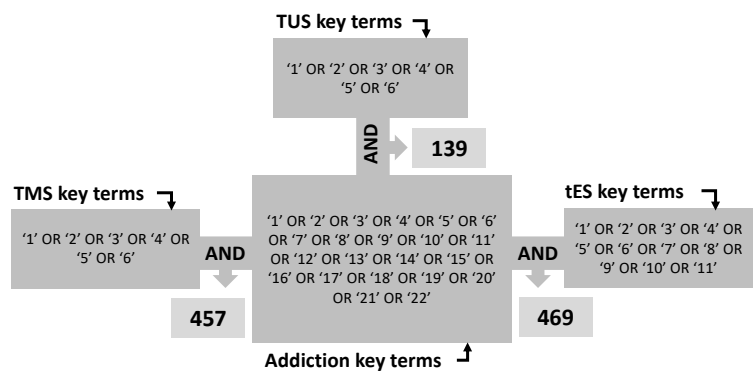
Figure 1: Combination of key terms for systematic search and the total number of studies in the initial search. Abbreviation: TMS: transcranial magnetic stimulation, tES: transcranial electrical stimulation, TUS: transcranial focused ultrasound. The key terms for TMS: 1-“transcranial magnetic stimulation”, 2-TMS, 3-rTMS, 4-“theta burst stimulation”, 5-cTBS, 6-iTBS. The key terms for tES: 1-“transcranial direct current stimulation”, 2-tDCS, 3-tES, 4-“transcranial electrical stimulation”, 5-tCS, 6-“transcranial current stimulation”, 7-“transcranial Alternating Current Stimulation”, 8-tACS, 9-“transcranial random noise stimulation”, 10-tRNS, 11-“electrical stimulation”. The key terms for TUS: 1-“transcranial focused ultra sound”, 2-“tFUS”, 3-“TUS”, 4-“transcranial Ultrasound”, 5-“HIFU”, 6-“LIFU”. The key terms related to addiction: 1-addiction, 2-“substance use”, 3-“substance abuse”, 4-“substance related disorder”, 5-“drug abuse”, 6-“behavioral addiction”, 7-dependency, 8-craving, 9-alcohol, 10-nicotine, 11-tobacco, 12-smoking, 13-cigarette, 14-cannabis, 15-opioid, 16-marijuana, 17-crack, 18-cocaine, 19-morphine, 20-heroin, 21-methamphetamine, 22-caffeine.
Inclusion/Exclusion criteria and data extraction
The initial search yielded a total of 457 articles on TMS, 469 articles on tES, and 139 articles on TUS. Two independent investigators (AS, HT) reviewed the list of included studies and collected the coded data and the 3rd investigator (GS) reviewed the collected databases and solved the conflicts under the supervision of the PI of the study (HE). During the initial screening, based on titles and abstracts, 171 TMS records, 256 tES records, and 139 TUS records were excluded. The reasons for exclusion were being book chapters, commentaries, author corrections, editorials, and studies focused on disorders other than substance use disorders (SUDs). One TMS study was also identified as a duplicate under a different title. Subsequently, 285 TMS articles and 213 tES articles progressed to the next stage, which involved full-text screening to identify eligible articles. A precise full-text review was conducted, resulting in the inclusion of 116 TMS articles and 82 tES articles. Exclusion criteria at this stage included review articles, studies with only healthy subjects, case reports and case series, studies involving subjects other than humans, study protocols, electric field modeling, and studies published in languages other than English. Single or paired-pulse TMS studies were excluded, while studies on repetitive transcranial magnetic stimulation (rTMS) and deep transcranial magnetic stimulation (dTMS) were included. Notably, no published study utilizing transcranial random noise stimulation (tRNS) in the field of tES was identified after the year 2000. The PRISMA flowcharts illustrating the inclusion/exclusion procedure for TMS, tES, and TUS studies are presented in Figure S1, Figure S2, and Figure S3 respectively. No TUS study met our inclusion/exclusion criteria, and all following results are based on TMS and tES articles.
Publication details, including the country of publication (where the first affiliation of the first author is located or the affiliation of the majority of the authors if the country of the first author was unclear), the publication year (based on PubMed’s indexing), the main substance(s) of interest in the study, the main site of stimulation (were stimulating electrode or coil is placed), the number of active stimulation sessions (participants received active tES or TMS), the number of subjects in the active arms, and the number of female subjects in the active arm were extracted. We categorized the current status of participants and there were four distinct time intervals at which the interventions were administered: (1) before the participant sought standard treatment (2) while the subject was treatment seeking but before undergoing standard treatment, (3) within the first month of standard treatment (mainly detoxification and stabilization) and (4) after the initial recovery period (more than one month). Additionally, the duration of the follow-up period, the control condition (active, sham, another therapy, another clinical population, or no-control conditions), the randomization method, the coil/electrode positioning system, the stimulation dose (for TMS: site of pulses, stimulation type, frequency, intensity, and the number of pulses; for tES: anode/cathode size and location, stimulation intensity, and duration), and the primary/secondary outcome measures were extracted. Additionally, a binary rating system (Yes/No) was used to indicate whether a study observed any significant effects on a specific outcome measure in response to the stimulation. We also checked if computational head models were generated for electric field distribution pattern assessment.
Quality of rating assessment
After finalizing included articles, literature search results were imported to two separate sheets for tES and TMS studies. Data extracted from all literature were filled into a spreadsheet by AS and HT. Consistency between the authors was honed through a calibration exercise in which all authors evaluated and discussed their ratings for 20 randomly chosen studies (Tricco et al., 2018). GS and HE further refined the data extraction form to reduce inconsistency and ambiguity after the exercise. Data on study design features and basic methodological parameters were extracted first, and each article was reviewed independently by two investigators (AS and HT) in two separate spreadsheets, with inconsistencies resolved in discussions with GS under the supervision of HE.
Despite following a similar data extraction policy to the previously published INTAM systematic review, a comprehensive screening of the literature from 2000 to 2018 was conducted once again to ensure the absence of any inconsistencies. This step was taken to guarantee the accuracy and reliability of the extracted data. By re-screening the entire range of publications within the specified timeframe, potential discrepancies or errors in the data extraction process were identified and rectified. This meticulous approach aimed to maintain the integrity and consistency of the review, providing a robust foundation for the analysis and conclusions drawn from the included studies.
Explanation of the live systematic review approach
Main data extraction and main figures were uploaded on the INTAM OSF page (https://osf.io/sv8ky/). This database will be updated every year over this webpage and final results will be published every five years.
Review of previous systematic reviews and meta-analyses
To comprehensively assess the existing review literature on the role of TMS, tES, or TUS in addiction, we conducted a thorough review of all previous systematic reviews and meta-analyses. The identification of these reviews was accomplished through our key search terms. For each identified systematic review and meta-analysis, we extracted relevant information, including the type of intervention employed, the specific type of addiction investigated, the number of studies covered in the review, the total number of subjects included, the main outcome measures utilized, and the final results reported. To present a concise summary, we compiled this information into a comprehensive table, providing an overview of the key findings from the previous reviews and meta-analyses in the addiction field (See Table 2).